Laboratory and experimental learning
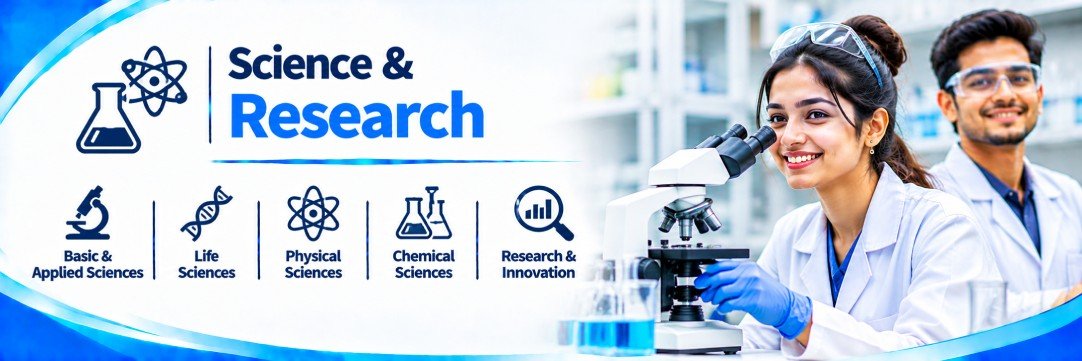
About the stream
What is Science & Research?
Science programmes build a foundation in the natural, physical, mathematical and life sciences. Learners explore scientific principles through lectures, experiments, fieldwork, computation and research methods.
Explore your optionsUndergraduate · Postgraduate · Diploma · Doctoral · Professional pathways
Course directory
Programs Offered in Science & Research
Programme names and availability vary by university, campus and academic session. Explore common course pathways below.
- B.Sc. (Physics, Chemistry, Mathematics)
- B.Sc. Biology / Zoology / Botany
- B.Sc. Biotechnology
- B.Sc. Microbiology
- B.Sc. Biochemistry
- B.Sc. Environmental Science
- B.Sc. Statistics
- B.Sc. Forensic Science
- Integrated M.Sc.
- M.Sc. subject specialisations
- Ph.D. in Science disciplines
Learning experience
Key Features of Science & Research Programs
Research methods and data analysis
Field studies and scientific projects
Pathways to postgraduate and doctoral research
Admission guide
Admission Eligibility
These are broad entry patterns, not a substitute for the current prospectus. Final eligibility is set by the university and, where applicable, the statutory regulator or professional council.
- B.Sc.: usually Class 12 in the relevant science subjects; subject combinations and minimum marks vary by discipline and institution.
- M.Sc.: usually a relevant bachelor's degree, sometimes with specified subject credits.
- Ph.D.: a relevant postgraduate degree and the institution's entrance/interview or other prescribed selection process.
Future pathways
Career Scope After Science & Research
✓Laboratory and quality-control roles
✓Biotechnology and life-science industries
✓Environmental monitoring and sustainability
✓Data, statistics and scientific computing
✓Scientific research and teaching (with required qualifications)
✓Further study and specialised research
Career outcomes depend on the chosen qualification, practical skills, experience, location, recruitment requirements and any mandatory professional registration.
Common questions
Frequently Asked Questions
Can commerce or arts students apply for B.Sc.?
Most B.Sc. science subjects require relevant Class 12 science subjects. Some interdisciplinary programmes may have different entry rules.
What can I do after B.Sc.?
Options include postgraduate study, laboratory work, quality roles, analytics, industry, teaching and research, depending on subject and additional qualifications.
Is research included in science degrees?
Many programmes include practicals, projects or research exposure; the depth and format depend on the curriculum and institution.
Plan your next step with confidence